Is the Moon a Planet Is Pluto a Planet Again
For 76 years, Pluto was the beloved 9th planet. No one cared that it was the runt of the solar organisation, with a moon half its size. No 1 minded that information technology had a tilted, oval-shaped orbit. Pluto was a weirdo, only information technology was our weirdo.
"Children place with its smallness," wrote scientific discipline writer Dava Sobel in her 2005 bookThe Planets. "Adults relate to its … existence as a misfit." People felt protective of Pluto.
So information technology was possibly not surprising that at that place was public uproar when Pluto was relabeled a dwarf planet 15 years ago. The International Astronomical Matrimony, or IAU, redefined "planet." And Pluto no longer fit the neb.
This new definition required a planet to practice three things. First, it must orbit the sun. Second, it must have plenty mass for its own gravity to mold information technology into a sphere (or close). Third, it must have cleared the space around its orbit of other objects. Pluto didn't laissez passer the 3rd test. Hence: dwarf planet.
"I believe that the decision taken was the correct one," says Catherine Cesarsky. She was president of the IAU in 2006. She's currently an astronomer at CEA Saclay in France. "Pluto is very different from the eight solar-system planets," she says. Plus, in the years leading up to Pluto'due south reclassification, astronomers had discovered more objects beyond Neptune that were like to Pluto. Scientists either had to add many new planets to their list, or remove Pluto. It was simpler to but give Pluto the boot.
"The intention was not at all to demote Pluto," Cesarsky says. Instead, she and others wanted to promote Pluto as 1 of an important new grade of objects — those dwarf planets.

Some planetary scientists agreed with that. Among them was Jean-Luc Margot at the Academy of California Los Angeles. Making information technology a dwarf planet was "a triumph of science over emotion. Science is all virtually recognizing that earlier ideas may have been wrong," he said at the time. "Pluto is finally where it belongs."
Others have disagreed. Planets should not have to clear their orbits of other debris, argues Jim Bell. He's a planetary scientist at Arizona Land University in Tempe. An object'due south ability to cast out debris does non just depend on the body itself, Bell says. Then that shouldn't disqualify Pluto. Everything with interesting geology should be a planet, he says. That manner, "it doesn't affair where you are, it matters what you lot are."
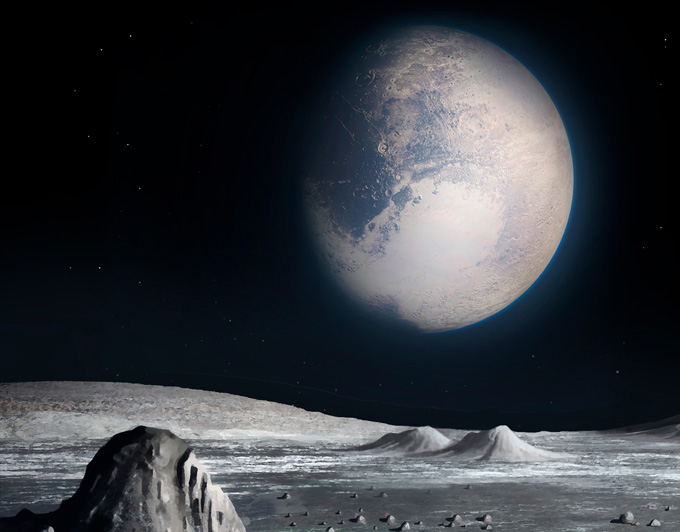
Pluto certainly has interesting geology. Since 2006, we've learned that Pluto has an atmosphere and mayhap fifty-fifty clouds. It has mountains fabricated of water ice, fields of frozen nitrogen and methane snow-capped peaks. It even sports dunes and volcanos. That fascinating and agile geology rivals any rocky globe in the inner solar organization. To Philip Metzger, this confirmed that Pluto should count as a planet.
"There was an firsthand reaction confronting the dumb [IAU] definition," says Metzger. He's a planetary scientist at the Academy of Central Florida in Orlando. But science runs on prove, not instinct. Then Metzger and colleagues have been gathering evidence for why IAU's definition of "planet" feels so wrong.
The ascension and fall of Pluto
For centuries, the word "planet" was much more inclusive. When Galileo turned his telescope on Jupiter in the 1600s, any large moving body in the sky was considered a planet. That included moons. In the 1800s, when astronomers discovered the rocky bodies at present called asteroids, they called those planets, too.
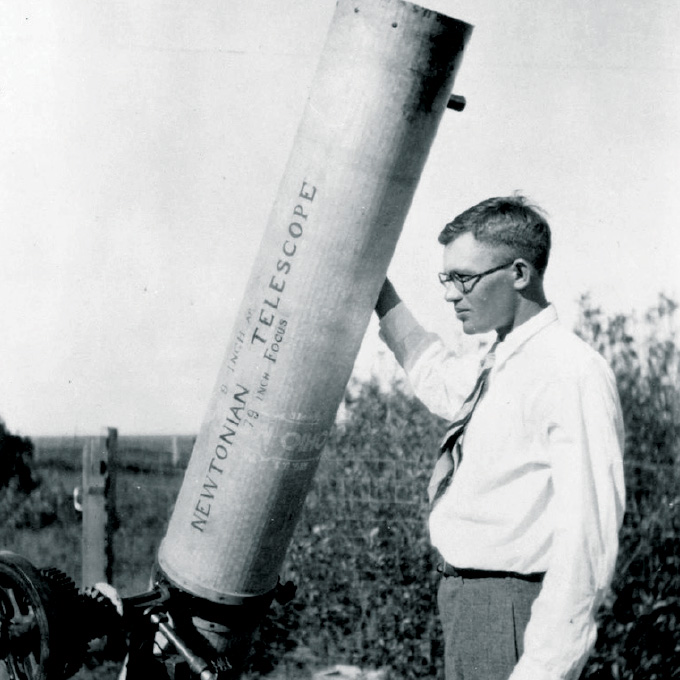
Pluto was seen as a planet from the very beginning. Amateur astronomer Clyde Tombaugh first spotted it in telescope photos taken in January 1930. At the time, he was working at the Lowell Observatory in Flagstaff, Ariz. Upon his discovery, Tombaugh rushed to the observatory manager. "I take found your Planet Ten," he declared. Tombaugh was referring to a ninth planet that had been predicted to orbit the sun across Neptune.
But things got weird when scientists realized Pluto wasn't alone out in that location. In 1992, an object about a 10th as wide every bit Pluto was seen orbiting out beyond it. More than two,000 icy bodies accept since been institute hiding in this frigid outskirt of the solar system known as the Kuiper (KY-pur) Belt. And in that location may be many more withal.
Finding that Pluto had so many neighbors raised questions. What did these foreign new worlds accept in common with more familiar ones? What set them apart? Suddenly, astronomers weren't sure what truly qualified as a planet.
Mike Brown is a planetary scientist at the California Institute of Technology in Pasadena. In 2005, he spotted the commencement Kuiper Belt trunk that appeared larger than Pluto. It was nicknamed Xena, in accolade of the Telly showXena: Warrior Princess. This icy body was left over from the formation of the solar system. If Pluto was the ninth planet, Brown argued, so surely Xena should exist the 10th. Merely if Xena didn't deserve the championship of "planet," Pluto shouldn't either.

Tensions over how to categorize Pluto and Xena came to a head in 2006. The drama peaked at an IAU coming together held in Prague, the capital of the Czech republic. On the concluding twenty-four hour period of the Baronial coming together, and subsequently much heated argue, a new definition of "planet" was put to a vote. Pluto and Xena were deemed dwarf planets. Xena was renamed Eris, the Greek goddess of discord. A fitting title, given its role in upsetting our concept of the solar organisation. On Twitter, Dark-brown goes by @plutokiller, since his research helped knock Pluto off its planetary pedestal.
Messy definitions
Right away, textbooks were revised and posters reprinted. Just many planetary scientists — especially those who study Pluto — never bothered to change. "Planetary scientists don't use the IAU's definition in publishing papers," Metzger says. "We pretty much simply ignore it."
In function, that might be sass or spite. But Metzger and others think there'southward also expert reason to reject IAU's definition of "planet." They make their case in a pair of papers. One appeared every bit a 2019 written report inIcarus. The other one is due out soon.
For these, the researchers examined hundreds of scientific papers, textbooks and letters. Some of the documents dated back centuries. They show that how scientists and the public have used the discussion "planet" has changed many times. And why was oft non straightforward.
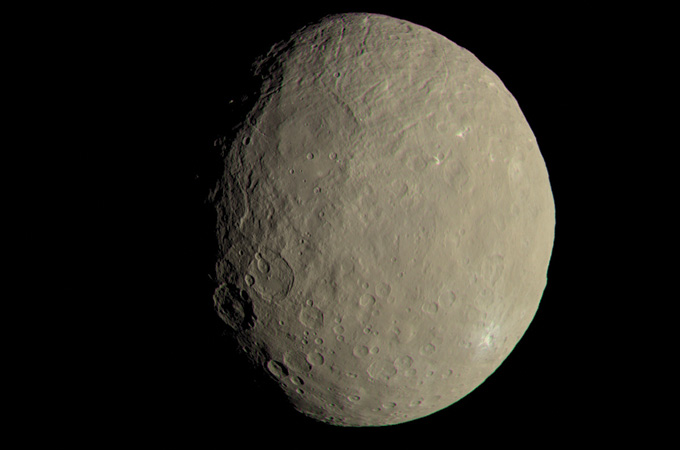
Consider Ceres. This object sits in the asteroid belt between Mars and Jupiter. Like Pluto, Ceres was considered a planet after its 1801 discovery. It's often said Ceres was lost its planethood after astronomers found other bodies in the asteroid belt. By the end of the 1800s, scientists knew Ceres had hundreds of neighbors. Since Ceres no longer appeared special, the story goes, it lost its planetary championship.
In that sense, Ceres and Pluto suffered the same fate. Correct?
That'south not the real story actually, Metzger's team now reports. Ceres and other asteroids were considered planets — admitting "modest" planets — well into the 20th century. A 1951 article inScience News Lettersaid that "thousands of planets are known to circle our dominicus." (Scientific discipline News Letter later on became Science News, our sister publication.) Nigh of these planets, the magazine noted, were "pocket-size fry." Such "infant planets" could be as small as a city block or equally wide equally Pennsylvania.
The term "minor planets" merely cruel out of way in the 1960s. That's when spacecraft got a closer expect at them. The largest asteroids still looked like planets. Most small ones, however, turned out to be weird, lumps. This provided evidence that they were fundamentally unlike than the bigger, rounder planets. The fact that asteroids didn't clear their orbits had nothing to do with their name alter.
And what most moons? Scientists called them "planets" or "secondary planets" until the 1920s. Surprisingly, people didn't stop calling moons "planets" for scientific reasons. The change was driven by nonscientific publications, such equally astrological almanacs. These books use the positions of angelic bodies for horoscopes. Astrologers insisted on the simplicity of a limited number of planets in the heaven.
Just new information from space travel subsequently brought moons back into the planetary fold. Starting in the 1960s, some scientific papers once again used the word "planet" for objects orbiting other solar system bodies — at to the lowest degree for some big round ones, including moons.
In brusque, the IAU definition of "planet" is simply the latest in a long line. The word has changed meanings many times, for many different reasons. And so there'south no reason why it couldn't be changed over again.
Real-world usage
Defining "planets" to include certain moons, asteroids and Kuiper Belt objects is useful, Metzger now argues. Planetary science includes places like Mars (a planet), Titan (one of Saturn's moons) and Pluto (a dwarf planet). All these places have extra complication that arises when rocky worlds become large enough to become spherical. Examples of that complexity span from mountains and atmospheres to oceans and rivers. It's scientifically useful to have an umbrella term for such circuitous worlds, Metzger says.
"Nosotros're non claiming that we have the perfect definition of a planet," he adds. Nor does Metzger retrieve everyone need adopt his. That's the mistake the IAU made, he says. "We're saying this is something that ought to be debated."
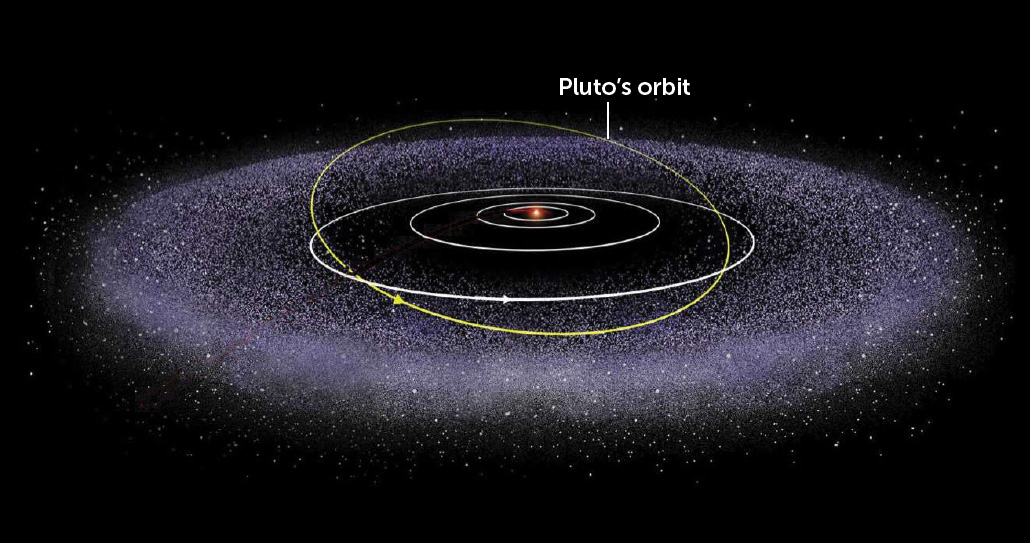
A more than inclusive definition of "planet" might also give a more than accurate concept of the solar arrangement. Emphasizing viii major planets suggests they boss the solar organization. In fact, the smaller stuff greatly outnumbers those worlds. The major planets don't even stay in stock-still orbits over long time-scales. Gas giants, for instance, take shuffled around in the past. Viewing the solar system as just eight unchanging bodies may not practice that complexity justice.
Brown (@plutokiller) disagrees. Having the gravitational oomph to nudge other bodies effectually is an important characteristic of a planet, he argues. Plus, the eight planets conspicuously boss our solar arrangement. "If yous dropped me in the solar system for the first time, and I looked around … nobody would say anything other than, 'Wow, at that place are these viii — choose your word — and a lot of other little things.'"
One common argument for the IAU definition is that it keeps the number of planets manageable. Can you lot imagine if there were hundreds or thousands of planets? How would the average person continue rail of them all? What would we impress on luncheon boxes?
But Metzger thinks counting just viii planets risks turning people off to the residual of infinite. "Back in the early 2000s, there was a lot of excitement when astronomers were discovering new planets in our solar arrangement," he says. "All that excitement ended in 2006."
Yet many of those smaller objects are still interesting. Already, in that location are at least 150 known dwarf planets. About people, however, are unaware, Metzger says. Indeed, why do we need to limit the number of planets? People tin memorize the names and traits of hundreds of dinosaurs or Pokémon. Why non planets? Why not inspire people to rediscover and explore the space objects that most entreatment to them? Maybe, in the end, what makes a planet is in the eye of the beholder.

simonsonfacen1988.blogspot.com
Source: https://www.sciencenewsforstudents.org/article/pluto-dwarf-planet-definition-iau-astronomy
0 Response to "Is the Moon a Planet Is Pluto a Planet Again"
Post a Comment