What Percentage of Adoptive Families Want to See Their Biological Parents
Children removed from their biological parents because of abuse or neglect enter a child welfare system that is broken and needs to be fixed. The number of children in foster intendance has about doubled in the by fifteen years while the number of potential foster families has declined. Foster intendance was designed to provide a temporary home for children who would eventually be reunited with their parents or adopted. But not all parents can exist rehabilitated and many children—older, handicapped, and minority children—are difficult to place in adoptive homes.
This brief argues the need to face this crunch in the child welfare system by broadening the options available to include besiege care or group homes that would provide a more than stable surround for these children.
In early 2000, the Washington Postal service chronicled a Washington, D.C., kid welfare case in which two-year-old Brianna Blackmond was returned from a loving foster family to her biological mother. Within weeks, she was dead. Police are investigating not but how she died, but how the legal and child welfare arrangement failed to protect her from a parent who was not competent to care for her. Cases such equally this enhance a troubling question: what should be done about the many children who are placed in foster care and whose biological parents cannot exist rehabilitated?
When children are removed from their biological parents considering of neglect or corruption, they are placed in foster care, kinship care (with relatives), adoptive homes, or, much less oft, in group homes. These options were designed to accost a kid's varied needs and circumstances, just child welfare professionals more often than not prefer to proceed children with their biological parents. This preference comes into serious question when children such as Brianna endure severe corruption or neglect, or even die, at the hands of their parents.
The child welfare system does not like to give up on any troubled parent considering of a long-held belief that given the proper resource, everyone can be rehabilitated. Child welfare workers believe they should make every effort to keep a child within the biological family unit, and many judges are unwilling to terminate parental rights until an adoptive family is found. The catch-22 is that information technology is hard to detect people willing to invest in condign pre-adoptive caregivers if they accept no guarantee that they can eventually adopt the child. In that location is a special sensitivity to removing black children from their extended families because of the fragile nature and constant disruptions of poor blackness families in the wider society.
This policy brief argues for the need to reorient the child welfare field'southward response to the major crises confronting it past widening the options bachelor to include congregate intendance or grouping homes. All children deserve the right to abound up in a family setting. This does not always have to hateful two biological parents living under the same roof. It can also mean caregivers who provide a stable, safe, and loving environment with consistent subject, schedules, and routines that assist the kid develop to his or her total potential.
A Curt History of Foster Care
At the outset of the twentieth century, most big cities had children'south aid societies which "boarded out" children to a sponsor in the community who was paid to enhance the child until adoption. The societies besides boarded handicapped children and others who were unlikely to exist adopted. The modernistic adoption and foster intendance systems grew out of those early children'due south aid societies, whose ultimate goal was to find adoptive parents. Foster care was seen as brusque-term care for children who would eventually be reunited with their parents.
Toward the end of the twentieth century, the problems that crave removing children from their parents have worsened. Parents who are incarcerated, addicted to drugs, or homeless are unable to provide the quality of intendance children need. Drug addiction, for example, has had a profound impact on the need for out-of-home care. According to child welfare agencies, drug abuse is associated with 80 percent of substantiated corruption and neglect cases, and a report by the American Enterprise Institute estimates that the number of children in foster care increased about seventy pct because of cleft cocaine usage. To the extent possible, support services to proceed families together are preferable to those that simply remove the child without aiding the parents. But support services to assist parents with serious mental health or drug problems are in brusk supply. Moreover, information technology is very difficult to find adoptive homes for most children over nine years old, so many of them are shuffled back and along from foster care to their parents' homes.
Gild's views on what constitutes poor parenting, neglect, and abuse have besides changed. The absolute say-so parents once wielded and the stricter standards they imposed on children have been replaced by more child-oriented parenting styles and past kid abuse hotlines and child protective services that intervene when children are in danger. Greater diversity in the structures and functions of families have given rise to new definitions of what constitutes an effective setting in which to raise children. Loftier divorce rates, never-married parents, and cross-cultural adoption are all prove of this rapid societal transformation.
The rising in kinship care is some other contempo evolution and is a direct result of the view that it is less harmful to identify children inside the wider family circle, fifty-fifty if some of these placements are less than ideal. Foster intendance has functioned well for children who tin can return to rehabilitated parents, for children whose needs are short-term, and for children who tin can exist placed for adoption. Information technology has done less well with the large number of children who cannot be reunited with not-rehabilitated parents or be placed for adoption in a timely manner.
A System Curt on Resources
Safely reuniting children with parents who have been neglectful or abusive requires intensive, time-consuming work, because poverty and other systemic issues, such as drug habit and AIDS, resist quick fixes. The trained social workers charged with doing that work are in short supply in about foster care systems. For case, the District of Columbia Children's and Family Services Agency was placed in receivership by U.Due south. District Gauge Thomas F. Hogan in 1995 because it failed to provide the proper services to children in its care. At the stop of 1999, the courtroom-appointed receiver, Ernestine Jones, reported unacceptably high caseload levels in about every unit of the agency, and with simply two exceptions, the caseloads failed to come across the requirements ordered past the court.
Caseloads are large nationwide because of a short supply of trained child welfare workers who are given bereft resources to work with children whose needs are increasingly complex. At that place are no compatible national standards for the training that workers must run into. For example, Washington, D.C. courts require that workers take a principal's degree, making recruitment of staff difficult. The educational requirements in other cities are lower. In D.C., the starting salary for child welfare workers, who are required to accept a graduate degree in social work, is $38,000, compared to the starting salary for D.C. teachers with a bachelor's degree, which is $31,000. The inevitable results are low staff morale and loftier burnout rates.
A related problem is the "one size fits all" staffing pattern in child welfare agencies. Certification of workers and high standards are very important, simply many of the tasks—taking foster children to the doctor, for example—exercise non require a master's degree. Differential hiring and use of staff would help ease the burden.
Staff shortages could also exist alleviated if federal and local resources were made available to underwrite the formal grooming of staff at different levels. Tuition and in-service grants, higher salaries, on-the-job resources, and recruitment in loftier schools could attract more than people to the child welfare field. But fifty-fifty with adequate resources, safely reuniting all children with their biological parents will never be possible.
Adoption
For children who cannot be returned to their original homes, adoption would seem to be the respond. Only not all children are like shooting fish in a barrel to place. Healthy white infants are adopted rapidly, but older, handicapped, and minority children, forth with sibling groups of all races, are not. Figure i shows the distribution by race of children in foster care.
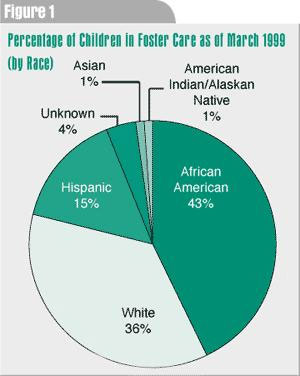
As of March 1999, at that place were 547,000 children in foster care in the U.s.. Source: AFCARS 1999. Online. Data Bachelor at:
http://world wide web.acf.hhs.gov/programs/cb/publications/afcars.htm
The reasons for the delays in the adoption procedure are numerous. Many biological parents are reluctant to relinquish their legal rights even after their children have been in foster treat years. The courts are often slow to terminate parental rights considering they, likewise, believe that biological parenthood supersedes all other considerations. Because society no longer stigmatizes unwed maternity, many single women facing difficult circumstances often try—and sometimes fail—to go along and raise their children. Therefore, many of the children who come into the foster care system are not healthy newborns. They are older, more than damaged, and potentially much harder to place, either for adoption or in foster intendance. Children can spend years in foster care, being moved from one home to another before a suitable placement is found.
In general, each kid who is adopted out of the foster care arrangement spends an average of iii years in public intendance, and about twenty percent remain in public care for five years or longer. A 1991 report on adoptions in twenty states showed that foster children for whom adoption is planned spend an average of iv to six years in foster care. The same holds truthful for the youngest foster children, those who should theoretically exist the easiest to place for adoption. In New York City, sixty percent of the infants discharged from hospitals to foster care were still in foster care three years subsequently. Over half of these babies had been placed in more than ane foster home since leaving the hospital and 1 out of six had been in three or more than homes, according to a 1993 report by the U.Due south. Section of Health and Human being Services. In March 1999, the hateful historic period of all children waiting to be adopted was 8, and over a quarter of them were over the age of 10.
"Special needs" children are peculiarly difficult to identify. These children are older, members of a minority or sibling grouping, or accept a mental, emotional, or concrete handicap. More than and more than foster children are falling into that category, with roughly eighty percent of parents who adopt children from the kid welfare system receiving the special needs adoption subsidy provided past the 1980 Family Reunification Act. Educators report that increasing numbers of foster children crave special education because of neurological, physical, and emotional bug.
Legislative Initiatives
The legislative history of child welfare services has swung from an emphasis on family reunification in the 1980s to a somewhat greater accent on adoption in recent years. Only Congress has never grasped the fact that, for an increasing number of children, neither is appropriate to their detail needs and circumstances.
Adoption Assistance and Child Welfare Act of 1980
In 1980, Congress enacted the Adoption Assist and Child Welfare Act, commonly known as the "Family unit Reunification" Deed. An essential feature of the constabulary is permanency planning, which means clarifying the intent of the placement, and, during temporary care, maintaining a plan to permanently identify the kid. The law mandated that country agencies behave periodic reviews for each child to reassess the necessity of placement, quality of care, and capability of the plan. But information technology also required state agencies to make "reasonable efforts" to prevent separation from biological parents, and when removal was necessary, agencies were to initiate a speedy reunion with the biological family.
The 1980 law did not successfully address the problems of children whose parents were difficult to rehabilitate. In fact, in a rush to comply with the law, underfunded public welfare agencies returned many children to marginally functioning parents who had not received acceptable services to aid in their recovery.
The law also attempted to encourage adoption of children in foster care by setting up a permanent organization of subsidies to help adoptive parents secure services for "special needs" children. Despite the subsidies, the adoption of foster care children decreased sharply. In FY1982, x.iv percentage of children leaving foster care were adopted. Past 1990, that share had fallen to 7.7 percent.
Adoption and Safe Families Act of 1997
In 1997, Congress tried to address deficiencies in the 1980 constabulary and encourage the adoption of more foster children by passing the Adoption and Prophylactic Families Act. Although the new law nonetheless requires states to make reasonable efforts to keep children out of foster care and to return them to the parental home if they are removed, it makes exceptions. States need non make efforts to preserve or reunify a family if a court finds the parent has subjected the child to "aggravated circumstances" such equally abandonment, chronic abuse, and sexual abuse. The provision of the police force also applies if the parent has killed another of his or her children, committed a felony set on against the child or a sibling, or had his or her parental rights to another child involuntarily terminated. Since the law'due south enactment, adoption out of foster care has been on the increase. In 1999, 15 percentage of children leaving foster intendance were adopted.
An Overloaded System
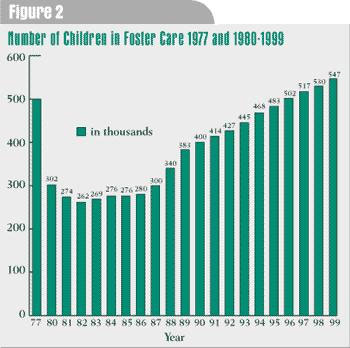
In 1983, in that location were 269,000 children in foster care, compared with 547,000 children today (see effigy 2). In FY2000, federal funding for foster care is $4.5 billion, for adoption aid, $one billion, and for Independent Living, $140 million. In FY2001, the Clinton Administration has asked Congress for $5 billion for foster care and $i.ii billion for adoption assistance.
Sources: Data for 1977 from the CQ Researcher (January 1998). Data for 1980-1996 taken from U.S. Committee on Ways and Ways; Green Book (May 1998). Child Protection Foster Care and Adoption Help. Department xi, pp. 752-53. Information for 1997- March 1999 from Adoption and Foster Care Analysis and Reporting Organization (AFCARS) for the reporting period 10/one/98 through 3/31/99. Bachelor at:
http://world wide web.acf.hhs.gov/programs/cb/publications/afcars.htm
.
Although the number of children in foster care has nearly doubled in the past 15 years, the number of potential foster families has declined. An overloaded organization is attempting to provide care for children for whom it was neither created, nor is currently configured to serve. In fact, although the number of children in foster care is ascension, the number of new admissions into intendance is not. (Admissions have been up and down since 1994.) This suggests that the rise number of children in foster care is due to increases in the length of stay or to changes in the mix of children inbound care.
Fixing the System: Besiege Intendance?
The kid welfare arrangement is cleaved and needs to exist fixed. There are more than children than ever in foster care, besides few social workers and potential adoptive parents, a declining number of potential foster families, and fewer children being returned to their biological families. The question is what to do with children who are unlikely either to be reunited with their parents or adopted. The option of congregate (institutional) care bears test.
Throughout most of the twentieth century, the popularity of congregate care steadily declined. Indeed, child welfare institutions came to be regarded equally bleak, Dickensian warehouses managed past cruel, untrained, and uncaring functionaries. Some criticism directed at the institutions was well-founded and led to the closing of substandard facilities. Past the latter half of the century, very few warehouse-fashion institutions for children existed. In add-on, the deinstitutionalization movement that swept through all types of big group facilities (i.e., mental institutions, homes for juvenile delinquents, and orphanages) in the United states helped close all traditional institutional facilities for children. In their identify—plain without widespread noesis by the public or fifty-fifty to many child welfare professionals—grew modern congregate intendance facilities, primarily a collection of family-style grouping homes staffed by trained childcare workers.
Some elected officials, frustrated by the difficulty of solving the myriad bug affecting children with special needs, have advocated reestablishing orphanages. In 1994, just before he became Speaker of the Business firm, Rep. Newt Gingrich (R-Georgia) set off a highly-charged national debate when he suggested that "orphanages" exist revived to care for the children of young and welfare-dependent single mothers. Kid welfare practitioners, policy analysts, and scholars attacked Gingrich's statement, saying that large and impersonal orphanages stymied healthy kid development. Child care workers at congregate facilities generally answered the critics by demonstrating that modern-twenty-four hour period orphanages are in fact more likely to resemble a suburban home or, as in the case of the highly-regarded international SOS Children's Villages, a group of well-kept, campus-style homes. Founded past Hermann Gmeiner in Austria, the program attempts to replicate a family setting by including a mother, brothers and sisters, and a house where they live permanently. Children's Villages are now located in Europe, Asia, Latin America, and Africa, and efforts are under manner to establish one in Washington, D.C.
Some other model of a congregate care facility in the Us is The Villages, founded in 1964 by Dr. Karl Menninger, whose aim was to requite children permanent homes. The Villages, which at present include eleven homes in Kansas, were founded on the model of placing children in a home with surrogate parents for as long as necessary without moving them from one foster abode to another. According to a 1994 article in the Atlantic Monthly past Mary Lou Weisman, the children who live at The Villages observe such old-fashioned values every bit church building omnipresence, neat apparel, daily chores, set bedtimes, clean rooms, and obedience to adults. Counseling is available to children, as is access to psychotropic medications when necessary.
The oldest besiege care facility in the U.s.a. is Girard College, which was founded past philanthropist Stephen Girard and was opened in Philadelphia in 1848 to care for and educate children in need. Girard, who was the richest man in America when he died, believed that children should exist given the opportunity to cultivate the skills necessary for a successful life. Today, Girard College continues to help underserved children by providing boarding and education at no toll to every kid who attends school, which is housed on a 43-acre campus. It is abode to over 600 boys and girls in Grades 1 through 12, about all of whom come from unmarried-parent, lower income homes.
An Equal Identify for Congregate Care
The unique value of congregate care is that it tin can provide permanent homes and care by trained professionals for children who are unlikely to be adopted or to be placed in the stable, specialized (i.e., therapeutic) foster homes they require. Although congregate care is not appropriate for every kid, it can help convalesce both overcrowding and inappropriate foster care placements.
Equally noted, many child welfare professionals and the public prefer adoption and foster care to congregate intendance because they believe that the optimal environment for children's development is in a nuclear family unit setting. Almost certainly, they are correct. Notwithstanding, the fact is that fewer and fewer Americans are living in the traditional nuclear family, and that ideal family setting is virtually unattainable for many children now in public care. Intendance in besiege homes is certainly preferable to the intendance of biological parents who are neglectful and abusive. It is also preferable to the revolving door experience of besides many children in foster intendance. Children who have been damaged in their biological families and from multiple foster care placements can notice in congregate care skills to cope effectively and make a successful transition to adulthood.
The child welfare arrangement should give it an equal identify in the continuum of care options, along with adoption, foster care, and kinship intendance. The blazon of intendance a kid receives should depend on his or her circumstances, and the driving force at all times must be to provide stable, long-term intendance. Family reunification and kinship care should not take precedence over the child's needs for stability. Congregate care cannot solve all of the problems besetting the child welfare organisation, simply it provides a skillful alternative for many children.
simonsonfacen1988.blogspot.com
Source: https://www.brookings.edu/research/children-in-out-of-home-placements/
0 Response to "What Percentage of Adoptive Families Want to See Their Biological Parents"
Post a Comment